
Bitcoin’s bull trap is exposing the treasury split
Bitcoin’s bull trap is exposing the treasury split
Daily Perspective
Bitcoin’s rally above $66,000 failed to hold, with price falling back toward $63,000 ahead of the FOMC decision. Technical analysts cited failed resistance, weak momentum, and leveraged long liquidations as evidence that the move may have trapped late buyers. The bull-trap conclusion remains an interpretation, not a certainty, and today’s Fed communication could quickly change the setup.
Strategy has now gone five consecutive weeks without purchasing Bitcoin. Instead, it spent $25 million repurchasing STRC below par and increased its dollar reserve to $3.75 billion, enough to cover roughly 25 months of expected preferred dividends. Its Bitcoin holdings remain unchanged at 843,775 BTC.
Hyperscale Data continued in the opposite direction, adding Bitcoin and increasing its treasury to approximately 1,106 BTC.
Signals We’re Watching
Market signals
Observed
Bitcoin’s rally above $66,000 failed to hold, with price falling back toward $63,000 ahead of the FOMC decision. Technical analysts cited failed resistance, weak momentum, and leveraged long liquidations as evidence that the move may have trapped late buyers. The bull-trap conclusion remains an interpretation, not a certainty, and today’s Fed communication could quickly change the setup.
Strategy has now gone five consecutive weeks without purchasing Bitcoin. Instead, it spent $25 million repurchasing STRC below par and increased its dollar reserve to $3.75 billion, enough to cover roughly 25 months of expected preferred dividends. Its Bitcoin holdings remain unchanged at 843,775 BTC.
Hyperscale Data continued in the opposite direction, adding Bitcoin and increasing its treasury to approximately 1,106 BTC.
Signal
The market is no longer following one corporate Bitcoin playbook. Strategy is defending the financing structure. Hyperscale is still adding to the asset side. The better decision depends on liquidity, obligations, cost of capital, and the company’s ability to withstand another leg lower.
Capital structure signals
Observed
Strategy’s decision to repurchase STRC rather than buy Bitcoin reduces preferred shares outstanding and future dividend obligations. The company still has approximately $975 million available under its repurchase authorization.
The cash reserve improves near-term resilience, but it was funded through further MSTR issuance. Preferred holders receive more support while common shareholders absorb additional dilution.
Elsewhere, KULR and Smarter Web recently sold a combined 511 BTC to eliminate approximately $31.7 million in debt, reducing collateral, maturity, and potential dilution risks.
Signal
The best treasury decision during stress may be to reduce liabilities rather than increase Bitcoin holdings. That sounds obvious in conventional finance. In Bitcoin treasury circles, it apparently requires a small revolution.
Strategy and business-model signals
Observed
A growing group of treasury companies is pivoting toward AI and data center strategies after falling Bitcoin prices and collapsing equity premiums weakened their original accumulation models.
The pivots have not automatically restored investor confidence. Building AI infrastructure requires power, construction capital, customers, operating expertise, and financing that can withstand delays. A new sector label does not eliminate those requirements.
MARA’s leadership has made the tradeoff explicit, arguing that AI workloads can generate more value from electricity than Bitcoin mining under certain market conditions. The company also emphasizes that it operates as a digital infrastructure business and may sell Bitcoin when capital allocation warrants it.
Signal
Treasury companies are moving from a simple asset story into competing operating models. The survivors will need more than Bitcoin exposure or an AI announcement. They will need recurring economics and a clear reason for the public company to exist.
Policy signals
Observed
Today’s Federal Reserve decision is the immediate macro test. Markets largely expect unchanged rates, but investors remain sensitive to any indication that inflation concerns could keep policy restrictive or revive the possibility of another rate increase.
Bitcoin has increasingly traded alongside other liquidity-sensitive assets when yields rise and financial conditions tighten. The treasury companies built around it often amplify that movement because they add equity, leverage, dividend, and refinancing risks to the underlying Bitcoin exposure.
Signal
A treasury company does not need Bitcoin to collapse for its structure to come under pressure. Persistently expensive capital can weaken accumulation economics, close financing windows, and turn liquidity management into the dominant board priority.
Security and operational signals
Observed
Hyperscale describes its Bitcoin holdings as a source of strategic and financing flexibility while it continues developing an AI data center business.
That combination can create useful optionality, but it also creates competing claims on capital. Bitcoin purchases, data center construction, power access, debt service, and operating needs cannot all receive the same dollar.
Signal
A treasury asset becomes operationally important once management expects to use it for financing or expansion. Boards must distinguish Bitcoin that is genuinely held in reserve from Bitcoin that may eventually be pledged, monetized, or sold to fund the operating strategy.
What This Actually Means
The failed Bitcoin rally provides a useful stress test because it removes the comfort of easy appreciation.
When Bitcoin is rising, almost every treasury decision can be presented as successful. Buying looks visionary. Issuing equity looks accretive. Holding cash looks overly cautious. Selling debt looks like financial engineering.
A weaker market reverses the scrutiny.
Strategy’s five-week buying pause does not mean its Bitcoin thesis has changed. It means the company now has other priorities that compete with accumulation. The preferred securities require cash. STRC traded below par. The company responded by increasing reserves and repurchasing part of the obligation.
That is treasury management.
It is also an admission that accumulation cannot remain the automatic answer to every capital-allocation question.
Hyperscale continues buying because its circumstances are different. It is building a smaller position alongside an operating infrastructure business. Whether that approach proves stronger depends on whether the operating company generates enough cash and value to support both strategies.
The AI pivots deserve even more skepticism.
Some may become viable businesses. Others look like treasury companies replacing one fashionable narrative with another. Selling Bitcoin to fund AI infrastructure may be rational, but the project must outperform the alternatives after accounting for construction risk, financing costs, dilution, and execution.
The correct comparison is not:
Bitcoin versus AI.
It is:
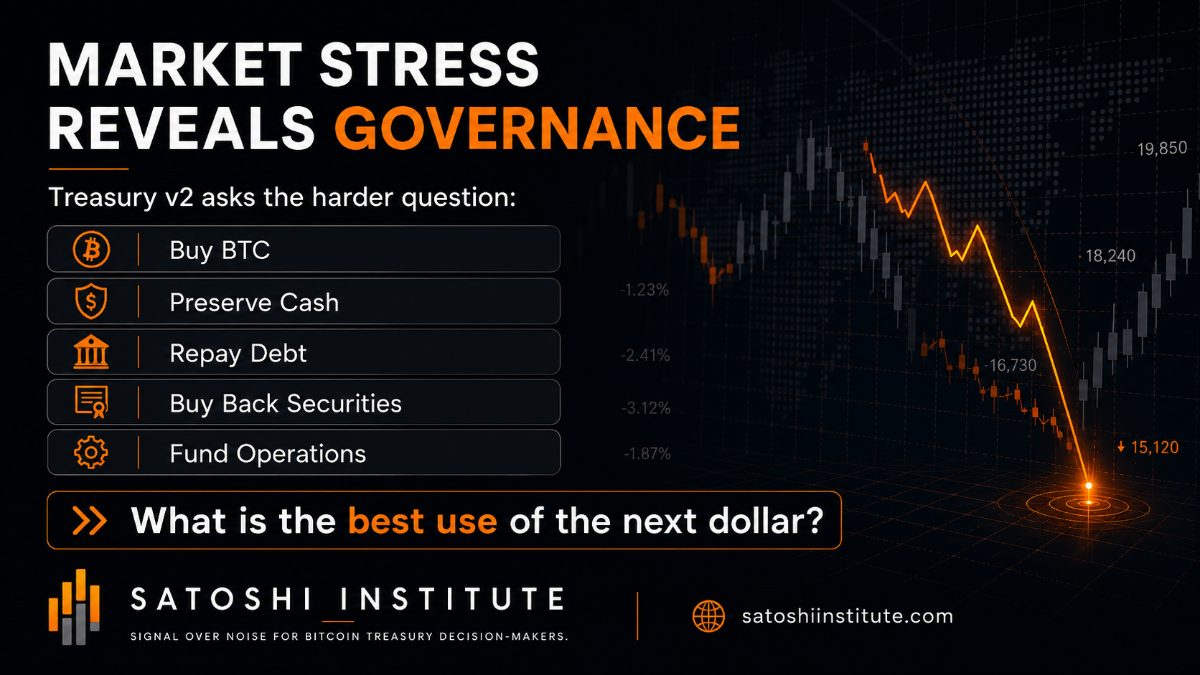
- Retain Bitcoin
- Preserve cash
- Repay debt
- Repurchase discounted securities
- Invest in operating infrastructure
Treasury v2 requires each option to compete for capital under the same governance process.