
Why Bitcoin treasuries are changing course, and new adopters are staying away
Why Bitcoin treasuries are changing course, and new adopters are staying away
Daily Perspective
A year ago, the Bitcoin treasury pitch sounded almost embarrassingly easy.
Announce the strategy. Raise capital. Buy Bitcoin. Watch the stock premium create capacity for the next purchase.
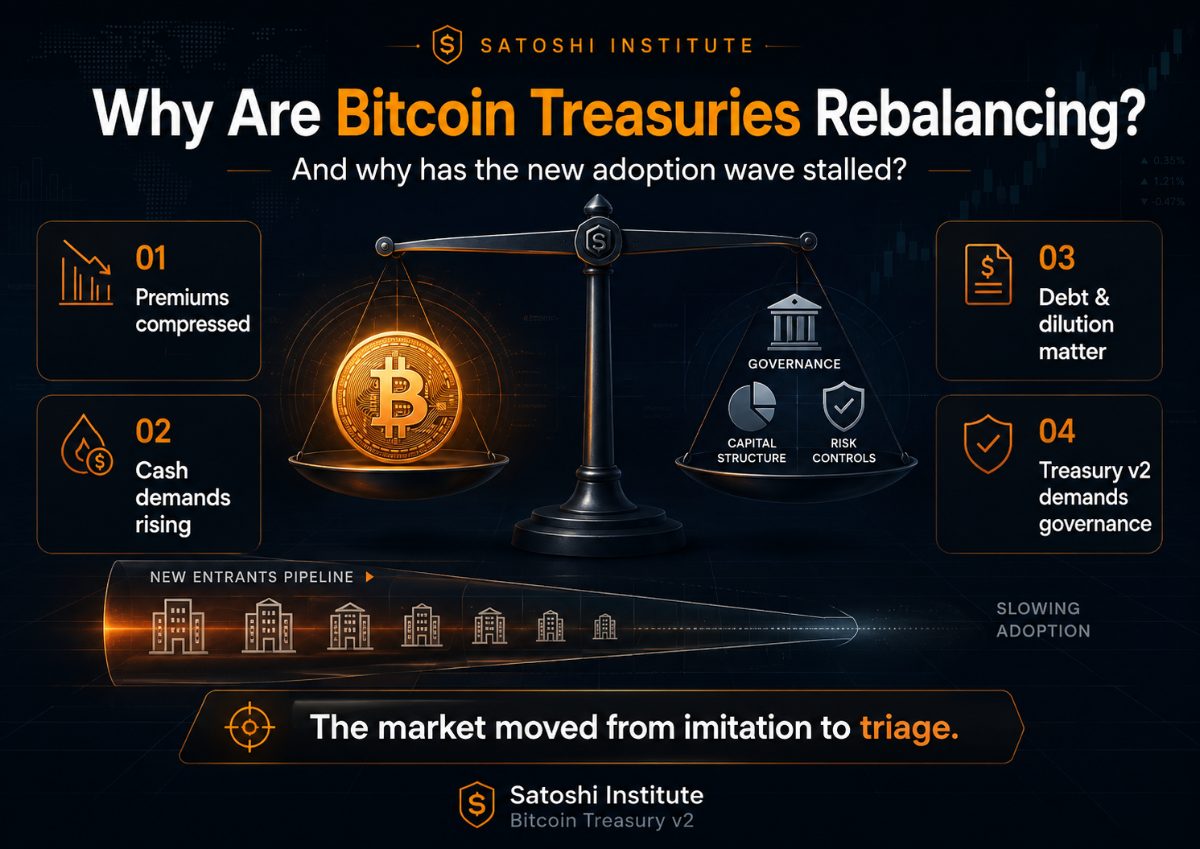
Now existing treasury companies are selling coins, building cash, repurchasing shares, reducing debt, pursuing yield, and attaching Bitcoin to operating businesses. At least 20 public companies have reportedly liquidated holdings, reduced exposure, or loosened their accumulation commitments.
At the same time, the parade of new adopters has slowed to a shuffle.
That is not because boards suddenly stopped believing in Bitcoin. It is because the corporate wrapper no longer comes with a complimentary valuation premium.
Signals We’re Watching
The financing advantage has largely disappeared
The original public-company treasury model depended on the stock trading above the value of the Bitcoin held by the company.
At a premium to net asset value, management could issue shares, buy Bitcoin, and increase Bitcoin per share. Once the stock falls below net asset value, the same transaction can dilute the very exposure shareholders came to own. By June, that premium had compressed across much of the sector.
Existing companies are therefore rebalancing because the trade that funded accumulation no longer works reliably.
New companies are staying away because they would be entering after the easy economics have already left the building.
Existing treasuries now have competing obligations
Strategy has moved from near-automatic accumulation toward active balance-sheet management. It has sold Bitcoin, increased cash, supported preferred dividends, and authorized security repurchases. Its latest sale of 1,638 BTC raised about $105 million while the company retained more than 842,000 BTC.
This is not abandonment of Bitcoin.
It is recognition that preferred holders, common shareholders, cash reserves, debt obligations, and the Bitcoin treasury all compete for the same capital.
A new adopter looking at Strategy today does not see a simple Bitcoin reserve policy. It sees a financial platform requiring considerable capital-market access and rather more adult supervision than the original presentation implied.
The market now punishes imitation
During 2024 and 2025, a Bitcoin treasury announcement could change how investors valued an otherwise ordinary company.
That novelty has faded.
Investors can obtain Bitcoin exposure through spot ETFs without accepting operating losses, executive risk, dilution, debt, preferred obligations, or the possibility that management will pivot into AI six months later.
The corporate wrapper must now provide something that direct Bitcoin ownership and ETFs do not:
- superior capital allocation
- operating cash flow
- disciplined financing
- tax or jurisdictional advantages
- credible governance
- measurable per-share accretion
Most prospective adopters cannot demonstrate that advantage. So they are not volunteering for the comparison.
Treasury companies bought near the top of the cycle
Many later entrants accumulated Bitcoin at materially higher prices and financed purchases when equity valuations were strongest.
As Bitcoin fell and treasury stocks traded at discounts, some firms faced shareholder pressure, debt repayment needs, or collapsing access to capital. Reuters reported that many digital asset treasury companies were trading below the value of their holdings, weakening their ability to raise funds and continue buying.
Boards considering a new strategy can now see the downside in real time.
The case study is no longer only Strategy’s historic success.
It also includes forced sales, shareholder revolts, reverse splits, abandoned SPAC transactions, debt refinancing, and companies discovering that Bitcoin is their most liquid asset when everything else needs money.
That tends to lengthen the board meeting.
The remaining adopters need a business model, not a press release
New treasury adoption has not stopped completely. Sono Group formally adopted a digital asset treasury strategy in March 2026, with plans to use Bitcoin and a covered-call approach after withdrawing support from its legacy solar operations.
But that example also reveals the change.
The next generation of adopters is unlikely to succeed by merely holding Bitcoin. Companies are trying to connect the treasury to yield, lending, mining, payments, infrastructure, or an operating business.
That can create real economics.
It can also create derivatives exposure, counterparty risk, collateral demands, operational complexity, and governance obligations that do not appear in the acquisition announcement.
The bar for adoption has risen because the strategy now has to survive due diligence.
What This Actually Means
Bitcoin treasury companies are not all retreating.
They are adapting to the loss of the conditions that made Treasury v1 appear effortless.
The first phase rewarded accumulation because three factors worked together:
- Bitcoin was rising.
- Treasury stocks traded at substantial premiums.
- Capital markets were willing to fund repeated purchases.
When those conditions weakened, the strategy stopped being self-reinforcing.
Companies were left with the Bitcoin, but also with the financing structures built to acquire it.
That is why they are now rebalancing.
Some are building cash because recurring dollar obligations cannot be paid with conviction.
Some are repurchasing discounted securities because retiring claims may create more per-share value than buying additional Bitcoin.
Some are selling Bitcoin to repay debt because survival outranks ideological purity.
Some are adding operating businesses because the market no longer rewards a passive wrapper.
Some are pursuing yield because idle Bitcoin does not cover corporate expenses.
Each response is different. The underlying pressure is the same.
The premium disappeared.
The absence of a visible new-adoption wave is the other side of that pressure.
Prospective boards can buy Bitcoin directly. They can use an ETF. They can allocate modestly without transforming the company’s identity. A full treasury strategy now requires them to answer questions that early adopters often postponed:
- Why should Bitcoin sit inside this company?
- What business purpose does it serve?
- How will purchases be financed?
- What happens below 1.0 mNAV?
- How much dilution is permitted?
- When may Bitcoin be sold?
- How much must remain unencumbered?
- What operating cash flow supports the structure?
- What makes the corporate wrapper better than an ETF?
Those are not objections to Bitcoin.
They are the beginnings of governance.
The slowdown may therefore be healthy.
Treasury v1 produced many announcements because the entry test was conviction.
Treasury v2 will produce fewer entrants because the entry test is institutional fitness.