
Bitcoin treasury companies are being forced to justify the company
Bitcoin treasury companies are being forced to justify the company
Daily Perspective
For a while, the corporate Bitcoin formula was wonderfully forgiving.
Raise capital. Buy Bitcoin. Announce the new total. Repeat.
Now Strategy is selling around the edges. Metaplanet is layering debt onto a 43,000 BTC treasury. Twenty One is talking about becoming something closer to Berkshire Hathaway. ETF sponsors are proposing products specifically designed to exploit treasury companies trading below NAV.
Apparently, "we own a lot of Bitcoin" is no longer enough of a corporate strategy.
That is probably healthy.
Signals We’re Watching
Metaplanet is turning the treasury into a financing platform
Metaplanet has launched its BitBonds program while holding roughly 43,000 BTC. The company reportedly used about 83% of a $500 million credit facility while building that position and has now begun issuing fixed-rate private debt.
The governance question is not whether the company still believes in Bitcoin. It clearly does. The question is how much of the treasury is supporting financing obligations, how much remains unencumbered, and what happens if Bitcoin stays weak while refinancing needs continue.
The larger the capital structure becomes, the less useful the headline BTC number becomes.
Strategy is proving that "never sell" was never a treasury policy
Strategy has now sold Bitcoin during multiple periods while increasing cash reserves and managing preferred obligations. That should not be treated as some ideological crisis. It is treasury management.
What matters is whether sales follow a defined capital-allocation policy, whether shareholders understand the hierarchy of obligations, and whether selling BTC preserves more value than the alternatives.
Treasury v1 treated selling as failure. Treasury v2 treats selling as one of several tools.
Twenty One may be pointing toward the next model
The conversation around Twenty One is becoming much more interesting than simple accumulation. One proposal discussed by market participants is for Twenty One to become a Berkshire-like vehicle, buying operating businesses or even becoming a public-market proxy for interests that investors cannot otherwise access.
Another idea is to acquire treasury companies trading below 1x mNAV.
That is a very different business.
Instead of asking investors to pay a premium simply because the company owns Bitcoin, management would use Bitcoin, capital markets, and discounted acquisitions to build an operating asset base. That begins to answer the uncomfortable question: Why should the company exist?
mNAV discounts are becoming an investable strategy
A proposed Bitcoin Treasury mNAV Discount ETF would reportedly buy treasury companies when they trade below 1.0x NAV. That tells us something important about where this market has gone. The premium used to be the story. Now the discount is becoming the opportunity.
Once investors begin treating these companies as discounted pools of assets rather than premium Bitcoin proxies, management has to produce value through capital allocation. Buying Bitcoin may still be one option.
Repurchasing stock, retiring debt, acquiring competitors, or buying operating assets may produce more value.
Yield is becoming another point of differentiation
BitMine is reportedly generating substantial annualized staking income from its ETH treasury. Meanwhile, Bitcoin treasury companies continue experimenting with preferred securities, lending, credit structures, and other ways to make the balance sheet productive.
That contrast will keep appearing. Bitcoin does not generate native yield. That is not necessarily a flaw. But companies promising income on top of Bitcoin have to manufacture that yield somewhere else.
Once they do, investors should ask where the risk moved.
What This Actually Means
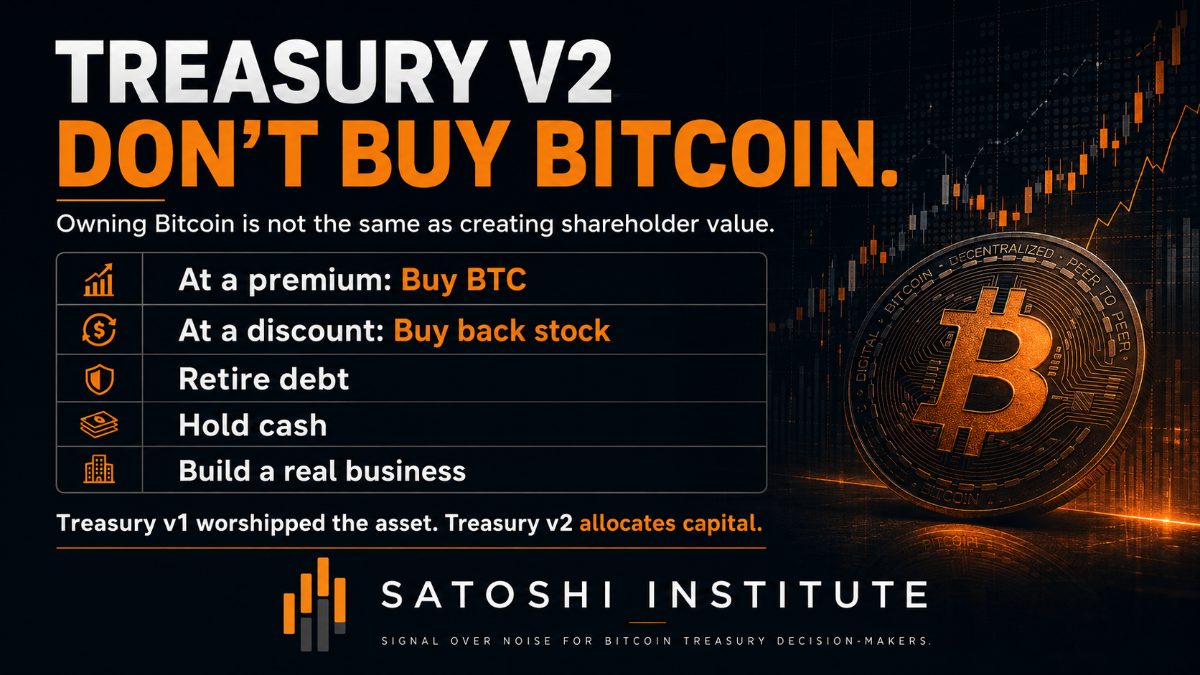
The corporate Bitcoin wrapper is being repriced. When treasury stocks traded at large premiums, management could issue equity, buy more BTC, and potentially increase Bitcoin per share. At or below NAV, that machine changes direction.
Now the board has choices.
- Buy Bitcoin.
- Repurchase discounted shares.
- Retire expensive debt.
- Protect liquidity.
- Acquire another discounted treasury company.
- Build an operating business.
Those decisions cannot be made by ideology. They require capital-allocation rules.
The best Bitcoin treasury company may eventually be the one that occasionally decides not to buy Bitcoin. That sentence would have sounded almost sacrilegious two years ago.
Today it sounds like corporate finance.